
Istg Meaning in Chat refers to “I swear to God.” The abbreviation appears in text messages, social media comments, DMs, group chats, gaming chats, and other casual online conversations. It adds extra force to a statement and can show sincerity, frustration, surprise, disbelief, excitement, or strong emotion.
For example, someone may write, “ISTG, I told you the truth.” Here, the sender wants to stress that the statement is honest. In another message, “ISTG this movie is amazing,” the same abbreviation adds strong excitement rather than a serious oath.
Dictionary.com lists ISTG as an abbreviation for “I swear to God” and notes uses linked with seriousness, exasperation, and surprise. Wiktionary also records ISTG as an internet-slang initialism.
What Does ISTG Mean?
ISTG means “I swear to God.” It is a shortened form of the full phrase, with each letter representing one word.
| Letter | Word |
|---|---|
| I | I |
| S | Swear |
| T | To |
| G | God |
The abbreviation usually works as an emphasis marker in casual conversation. A sender may use it to make a claim sound more sincere, add force to a complaint, or show a strong reaction.
Some common meanings behind ISTG are:
- I am telling the truth.
- I seriously mean it.
- I promise.
- I cannot believe this.
- I am very annoyed.
- I am strongly convinced.
- I am reacting dramatically or humorously.
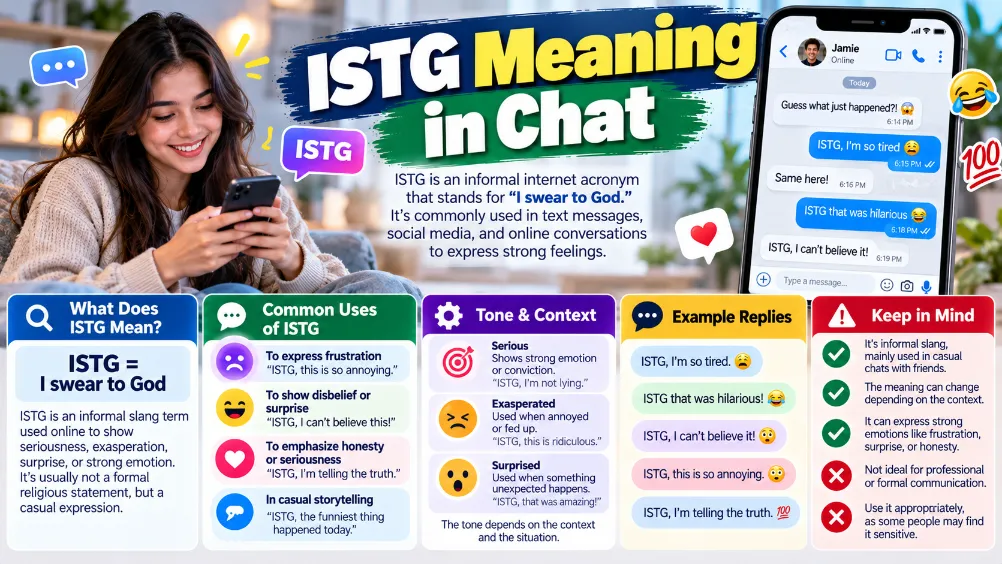
ISTG Meaning in Text Messages
In text messages, ISTG gives a sentence extra emotional weight. It can appear at the beginning, middle, or end of a message.
Examples:
- “ISTG, I did not take your charger.”
- “This is the funniest video ever, ISTG.”
- “ISTG I am going to finish this tonight.”
- “ISTG, why is my phone doing this?”
- “You actually won? ISTG!”
The exact feeling comes from the surrounding sentence. Capital letters, punctuation, emojis, and wording can also change how intense the message feels.
A message such as “istg 😂” may sound playful, while “ISTG!!!” can sound much stronger.
ISTG Meaning in Different Situations
ISTG does not carry one emotional tone in every conversation. The same four letters can serve several purposes.
| Situation | Example | Likely meaning |
|---|---|---|
| Honesty | “ISTG, I did not do it.” | Strong assurance |
| Promise | “ISTG I will call you later.” | Serious promise |
| Frustration | “ISTG, this keeps happening.” | Annoyance |
| Surprise | “ISTG, you actually won?” | Shock |
| Excitement | “ISTG, this song is perfect.” | Strong enthusiasm |
| Humor | “ISTG 😂 you are impossible.” | Playful exaggeration |
| Disbelief | “ISTG, that really happened?” | Strong reaction |
This range makes ISTG useful in relaxed digital conversations. The phrase can sound serious in one message and humorous in another.
How to Use ISTG in a Chat
ISTG works best in informal conversations with friends, relatives, gaming partners, online contacts, or social-media followers.
Common sentence patterns are:
- ISTG + statement: “ISTG, I saw him there.”
- Statement + ISTG: “That was wild, ISTG.”
- ISTG + promise: “ISTG I will finish it today.”
- ISTG + complaint: “ISTG, my internet keeps dropping.”
- ISTG + reaction: “ISTG, that was hilarious.”
The abbreviation fits naturally into short messages. It can also appear in comments, captions, memes, and replies.
ISTG in Social Media
ISTG appears across informal online spaces, such as Instagram, TikTok, Snapchat, X, messaging apps, and group chats. Its basic meaning remains “I swear to God” across these platforms.
Some examples are:
- “ISTG this cat is adorable.”
- “istg, I cannot stop laughing.”
- “That was the best game ever, ISTG.”
- “ISTG, my Wi-Fi always fails at the worst time.”
Platform names do not create a separate definition. The surrounding message gives the emotional meaning.
ISTG Uppercase vs Lowercase
Both ISTG and istg carry the same basic meaning. Capitalization mainly changes the visual style.
| Version | Typical style |
|---|---|
| ISTG | Stronger visual emphasis |
| istg | Relaxed and casual |
| Istg | Mixed-case texting style |
| ISTG!!! | Very strong emphasis |
A lowercase version can feel softer or more conversational. Uppercase letters plus several exclamation marks can make the message feel more forceful.
Is ISTG a Serious Expression?
ISTG can sound serious, but the phrase does not always function as a literal religious oath in online conversation. Dictionary.com notes that its online use generally falls outside a serious religious setting.
For example:
“ISTG, I did not break the vase.”
This may signal a serious attempt to convince someone.
“ISTG, that puppy is adorable.”
Here, the sender simply adds emotional emphasis.
The words around ISTG give the strongest clue about the intended tone.
Is ISTG Formal or Informal?
ISTG belongs to informal digital language. It fits casual chats and social-media conversations, but formal communication calls for clearer wording.
Avoid ISTG in:
- Job applications
- Business emails
- Academic assignments
- Official letters
- Formal reports
- Professional presentations
For formal writing, phrases such as “I assure you,” “I sincerely mean this,” or “I can confirm” provide a more suitable tone.
ISTG vs STG
ISTG and STG share the same basic phrase, but ISTG contains an additional I at the beginning.
| Slang | Full form | Common use |
|---|---|---|
| ISTG | I swear to God | Strong emphasis or assurance |
| STG | Swear to God | Emphasis or assurance |
Both expressions appear in casual digital communication.
ISTG vs OMG
ISTG and OMG can both express strong emotion, but their functions differ.
ISTG means “I swear to God” and usually adds force to a statement, promise, complaint, or reaction.
OMG means “Oh my God” and usually signals surprise, excitement, shock, or disbelief.
Examples:
- “ISTG, I told you already.”
- “OMG, that was amazing!”
The first stresses the speaker’s statement. The second reacts to something surprising or exciting.
Examples of ISTG in Everyday Chat
Here are natural examples of the slang in casual messages:
- “ISTG, I left my keys on the table.”
- “istg this game is so addictive.”
- “You made me laugh so hard, ISTG.”
- “ISTG, I am not making this up.”
- “That food was incredible, ISTG.”
- “ISTG, my laptop picked the worst time to freeze.”
- “I cannot believe you actually did that, ISTG.”
- “ISTG 😂 you always make things complicated.”
These examples show how the abbreviation can support serious statements, jokes, complaints, and enthusiastic reactions.
Where Did ISTG Come From?
The full phrase “I swear to God” existed long before internet slang. ISTG later appeared as a shortened online form. Wiktionary records an online example from July 2003, showing that the initialism was already in use on the internet by that period.
The exact invention date of the abbreviation remains unclear. The available record supports early-2000s online usage, rather than a precise origin date.
Can ISTG Sound Rude?
ISTG can sound rude or aggressive in certain messages, particularly alongside commands, threats, repeated punctuation, or angry wording.
For example:
“ISTG, stop doing that.”
This can sound irritated.
By contrast:
“ISTG 😂 that was hilarious.”
This sounds playful.
Tone depends heavily on the surrounding words and relationship between the chat participants.
How to Reply to ISTG
A suitable reply depends on the message.
| Message | Possible reply |
|---|---|
| “ISTG, I did not do it.” | “Okay, I believe you.” |
| “ISTG this is hilarious.” | “I know 😂” |
| “ISTG, I am so tired.” | “Same here.” |
| “ISTG I will call you.” | “Alright, I’ll wait.” |
| “ISTG, this keeps happening.” | “That sounds frustrating.” |
There is no special response required. A normal conversational reply usually works.
Final Meaning of ISTG
ISTG stands for “I swear to God.” In casual chat, it adds emphasis and can communicate honesty, a promise, frustration, surprise, disbelief, excitement, or humor.
The abbreviation appears in both uppercase and lowercase forms, and its tone comes from the surrounding message. ISTG works naturally in informal texting and social-media conversations, while formal communication calls for standard wording.