
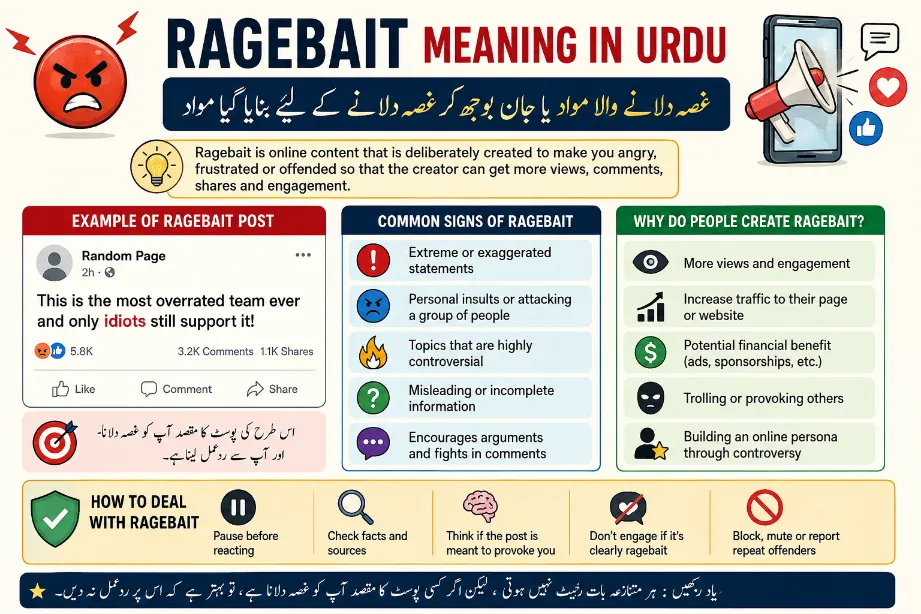
Ragebait Meaning in Urdu is “غصہ دلانے والا مواد”, “جان بوجھ کر غصہ دلانے والی پوسٹ” یا “ایسا مواد جو لوگوں کو مشتعل کرنے کے لیے بنایا جائے”۔
The term ragebait describes online content that is deliberately created to make people angry, frustrated, offended, or outraged. The goal is usually to attract attention, comments, shares, views, or other forms of engagement. Oxford defines rage bait as online content designed to provoke anger or outrage, often to increase traffic or engagement.
In simple words, ragebait is content that tries to make you angry so that you react to it.
Simple Ragebait Meaning Urdu Definition
Ragebait = ایسا آن لائن مواد جو جان بوجھ کر لوگوں کو غصہ دلانے یا مشتعل کرنے کے لیے بنایا جائے تاکہ زیادہ views، comments، shares یا engagement حاصل ہو۔
For example, someone may publish an intentionally insulting opinion about a popular celebrity, sports team, country, food, or social issue. The creator may expect people to disagree and start arguing in the comments.
What Does Ragebait Mean?
The word ragebait consists of two English words:
- Rage: شدید غصہ یا اشتعال
- Bait: کسی کو اپنی طرف متوجہ کرنے یا پھانسنے والی چیز
Together, ragebait refers to something designed to “bait” people into becoming angry.
It is closely related to clickbait, but there is an important difference. Clickbait generally tries to make people curious enough to click. Ragebait specifically tries to trigger anger, outrage, frustration, or confrontation. Oxford notes that rage bait has a more specific focus on anger, discord, and polarization than ordinary clickbait.
Ragebait Meaning in Urdu With Example
Consider a social media post that says:
“This is the most overrated football team in history, and only stupid people support it.”
The statement may be intentionally exaggerated rather than a genuine opinion. Supporters of the team may immediately respond with angry comments.
That reaction can benefit the creator because the post receives more:
- Comments
- Shares
- Views
- Replies
- Profile visits
- Social-media engagement
The post is therefore an example of ragebait if provoking that reaction was the creator’s intention.
Urdu Example of Ragebait Meaning
فرض کریں کوئی شخص سوشل میڈیا پر جان بوجھ کر یہ پوسٹ کرتا ہے:
“فلاں مشہور ٹیم دنیا کی سب سے خراب ٹیم ہے اور اس کے تمام مداح بے وقوف ہیں۔”
اگر پوسٹ کا مقصد مداحوں کو غصہ دلانا اور زیادہ comments یا shares حاصل کرنا ہے، تو اسے ragebait کہا جا سکتا ہے۔
How Does Ragebait Work?
Ragebait generally follows a simple pattern:
Provocative statement → Emotional reaction → Comments and arguments → More engagement → Greater visibility
A creator may deliberately use an extreme statement because anger can encourage people to respond immediately rather than calmly considering the claim.
Research on social-media engagement also shows that visible engagement signals can influence how users respond to low-credibility information, which helps explain why engagement-driven online environments can amplify problematic content.
However, not every controversial post is automatically ragebait. Intent matters. A person can genuinely express an unpopular opinion without trying to manipulate others into becoming angry.
Common Signs of Ragebait
Recognizing ragebait can help users avoid unnecessary online arguments. Some common signs include:
1. Extreme Statements
Ragebait frequently uses exaggerated language such as:
- “Everyone knows this is terrible.”
- “Only idiots believe this.”
- “This is the worst thing ever.”
- “Anyone who disagrees is stupid.”
Extreme wording can be used to provoke an immediate emotional response.
2. Personal Insults
Some posts attack groups of people rather than discussing an issue.
For example, instead of saying:
“I disagree with this opinion.”
a ragebait post might say:
“Anyone who believes this has no intelligence.”
The second approach is much more likely to create conflict.
3. Deliberate Controversy
Ragebait often focuses on subjects that already generate strong emotions, such as:
- Politics
- Sports
- Religion
- Celebrities
- Relationships
- Food preferences
- Social issues
- Popular entertainment
4. Misleading or Incomplete Information
Some ragebait relies on misleading claims, selective facts, or sensational headlines. Not every ragebait post is false, but misleading information can make provocative content even more effective.
5. Encouraging Arguments
A post may contain language specifically designed to encourage people to fight in the comments.
For example:
“I already know the comments are going to be angry.”
This can be a deliberate invitation for people to respond.
Ragebait vs Clickbait
Ragebait and clickbait are related but are not exactly the same.
| Feature | Ragebait | Clickbait |
|---|---|---|
| Main purpose | Trigger anger or outrage | Generate clicks |
| Main emotion | Anger, frustration, outrage | Curiosity, surprise |
| Typical format | Provocative post or statement | Sensational headline |
| Common result | Arguments and angry comments | Clicks and page visits |
| Example | “Only idiots like this movie.” | “You won’t believe what happened next!” |
Both techniques attempt to capture attention, but ragebait specifically uses anger or outrage as the hook.
Is Ragebait Always Fake?
No.
Ragebait can contain something that is technically true. The defining feature is not necessarily whether the statement is true or false; rather, it is the deliberate attempt to provoke anger or outrage.
For example, a creator might take a genuine event and present it in an unnecessarily insulting or inflammatory way simply to encourage people to react.
Similarly, an intentionally false claim may also be used as ragebait.
Therefore, users should separate two questions:
- Is the information accurate?
- Was the content designed to provoke a reaction?
Both questions matter.
Why Do People Create Ragebait?
There can be several motivations behind ragebait.
More Engagement
- Angry users may comment, quote, share, or reply to content. Even negative engagement can increase the amount of activity surrounding a post.
More Traffic
- A provocative post can send users toward a website, video, profile, or other piece of content. Oxford specifically identifies increased traffic and engagement as common purposes of ragebait.
Financial Benefits
- For some creators, increased attention can potentially translate into advertising revenue, subscriptions, sponsorship opportunities, or other forms of monetization.
Building an Online Persona of Ragebait
Some creators intentionally develop a provocative personality because controversy helps them remain visible.
Trolling
Ragebait can also overlap with trolling, where someone intentionally provokes others simply to enjoy their reactions. Merriam-Webster describes rage-bait as potentially including trolling behavior as well as content intended to generate attention or money.
Ragebait on Social Media
Ragebait is particularly common on platforms where users can quickly respond to posts and where engagement contributes to visibility.
It may appear as:
- Short videos
- Memes
- Social-media posts
- Comments
- Headlines
- Reaction videos
- Polls
- Screenshots
- Controversial opinions
- Edited clips
A creator doesn’t necessarily need to make a completely new argument. Sometimes an old controversial topic is repackaged with stronger language to encourage another round of discussion.
Cambridge Dictionary similarly defines a rage-baiter as someone who posts information, images, or videos online with the deliberate intention of making people angry and encouraging replies.
Examples of Ragebait
Here are some simple fictional examples:
Sports
“Your favorite team is only successful because its fans know nothing about football.”
The wording attacks supporters and encourages them to defend their team.
Movies
“Anyone who says this movie is good has terrible taste.”
The statement is framed to provoke fans.
Food
“People who eat pizza with pineapple don’t understand food.”
The creator may be trying to start an argument rather than have a serious discussion about taste.
Celebrity Content
“This celebrity has absolutely no talent, and everyone pretending otherwise is lying.”
Such a statement can encourage fans and critics to argue in the comments.
These examples demonstrate the technique without implying that the opinions themselves are objectively true or false.
How to Avoid Falling for Ragebait
The easiest way to reduce the impact of ragebait is to pause before reacting.
Before commenting on an inflammatory post, ask:
- Is this unusually provocative?
- Does the creator provide evidence?
- Is the wording designed to insult someone?
- Am I reacting emotionally?
- Would responding give the creator exactly what they want?
- Can I verify the claim from a reliable source?
If the content appears deliberately designed to provoke you, ignoring it may be more effective than arguing.
A Simple Rule
Pause → Check → Think → Respond or Ignore
This small habit can prevent unnecessary arguments and reduce the chance of spreading misleading content.
Ragebait Meaning in Urdu: Urdu Words You Can Use
Depending on the context, ragebait can be translated or explained in Urdu in several ways:
| English Term | Urdu Explanation |
|---|---|
| Ragebait | غصہ دلانے والا مواد |
| Ragebait content | مشتعل کرنے والا آن لائن مواد |
| Ragebait post | جان بوجھ کر غصہ دلانے والی پوسٹ |
| Ragebaiter | لوگوں کو جان بوجھ کر غصہ دلانے والا شخص |
| Ragebaiting | لوگوں کو غصہ دلا کر ردعمل حاصل کرنے کی کوشش |
| Outrage | شدید غصہ یا اشتعال |
| Provocative content | اشتعال انگیز مواد |
There is no single Urdu translation that perfectly captures every use of ragebait, so explaining the concept is often clearer than using one fixed translation.
Ragebaiter Meaning in Urdu
A ragebaiter is a person who deliberately creates or posts content designed to make other people angry.
In Urdu, it can be explained as:
“ایسا شخص جو جان بوجھ کر لوگوں کو غصہ دلانے والا مواد پوسٹ کرے تاکہ انہیں ردعمل دینے پر مجبور کیا جا سکے۔”
The person may benefit from the resulting comments, views, shares, or attention.
Ragebaiting Meaning in Urdu
Ragebaiting means deliberately using provocative statements, images, videos, or arguments to make people angry and encourage them to react.
In simple Urdu:
“لوگوں کو جان بوجھ کر غصہ دلانے اور ان سے ردعمل حاصل کرنے کی کوشش کو ragebaiting کہا جاتا ہے۔”
It can happen through a single post or as a repeated strategy across multiple posts.
Is Ragebait Harmful?
Ragebait is not necessarily harmful in every individual case, but repeated exposure to provocative content can contribute to hostile online discussions and make it harder to distinguish meaningful debate from deliberate provocation.
The problem becomes more serious when rage-inducing content is combined with misinformation, harassment, discrimination, or targeted abuse.
Research on misleading social-media content has also found that emotional reactions can become stronger when users encounter corrective information, illustrating how emotionally charged online discussions can escalate rather than resolve quickly.
For users, the practical lesson is simple: strong emotion is a reason to slow down, not necessarily a reason to share immediately.
How to Respond to Ragebait
You do not have to respond to every provocative post.
A useful approach is:
- Do not respond immediately.
- Check whether the claim is supported by evidence.
- Look for the original source when possible.
- Avoid repeating false claims just to criticize them.
- Use platform reporting tools when content violates rules.
- Block or mute accounts that repeatedly provoke you.
- Move away from conversations that have become abusive.
Sometimes the most effective response to ragebait is simply no response at all.
Is Every Controversial Opinion Ragebait?
No.
A controversial opinion can be completely genuine. Someone might strongly disagree with the majority while honestly expressing their view.
The difference often involves intent, presentation, and context.
For example:
Genuine disagreement:
“I don’t think this movie works because the story develops too slowly.”
Potential ragebait:
“Only clueless people could possibly enjoy this terrible movie.”
The second statement is more focused on provoking people than explaining an argument.
Still, outsiders cannot always know a creator’s private intentions with certainty. Therefore, it is better to describe content as “ragebait-like” or “apparently designed to provoke” when the intent cannot be established.
Why the Term Became Popular
The phrase has become increasingly prominent in online culture. Oxford University Press selected “rage bait” as its 2025 Word of the Year, reporting that its usage had tripled over the previous year. Oxford’s explanation connected the term with changing online attention patterns and the increasing importance of engagement in digital communication.
The rise of the term reflects a broader change in how people describe online manipulation. Users increasingly recognize that not all viral content is designed to inform or entertain; some content is specifically designed to generate an emotional response.
Final Words
Understanding Ragebait Meaning in Urdu makes it easier to recognize a common form of online communication. In simple terms, ragebait is ایسا مواد جو جان بوجھ کر لوگوں کو غصہ دلائے تاکہ وہ ردعمل دیں.
The important point is that not every controversial statement is ragebait. Genuine disagreement, criticism, and debate are normal parts of communication. Ragebait is different because the content is presented or created specifically to provoke an emotional reaction, often for attention or engagement.
When you encounter an unusually provocative post, taking a moment to verify the information and consider the creator’s likely purpose can help you avoid unnecessary arguments and prevent emotionally charged or misleading content from spreading further.
What is the Ragebait Meaning in Urdu?
Ragebait means غصہ دلانے والا یا مشتعل کرنے والا آن لائن مواد. It is content deliberately created to provoke anger or outrage, usually to obtain attention or engagement.
What is a ragebait example?
A deliberately insulting social-media post about a popular celebrity, sports team, or community can be ragebait when its purpose is to make people angry and encourage comments or arguments.
Is ragebait the same as clickbait?
No. Clickbait primarily uses curiosity to encourage clicks, while ragebait specifically uses anger, outrage, or frustration to encourage reactions.
What does ragebaiter mean?
A ragebaiter is someone who deliberately creates or posts provocative content to make other people angry and encourage them to respond.
Can ragebait be true?
Yes. Ragebait does not have to be completely false. A true statement can still be presented in a deliberately inflammatory way to provoke anger.
How can I identify ragebait?
Look for extreme language, personal insults, unsupported claims, deliberate controversy, and wording that seems designed to make you react immediately.