
Death Poetry in Urdu expresses grief, remembrance, separation, and the emotional pain associated with losing someone dear. Urdu has a long literary tradition of mourning poetry, with poets using simple yet powerful language to describe absence, memories, mortality, and the passage of life. In classical Urdu literature, marsiya developed as an important elegiac form, while shorter sad verses and poetic expressions of loss have remained popular in everyday literary culture.
What Is Death Poetry in Urdu?
Death poetry refers to verses written around death, loss, remembrance, and mourning. Such poetry may be personal, philosophical, religious, or literary. A poem can mourn a family member, friend, poet, historical personality, or another person whose passing has left an emotional impact.
The broader literary tradition of elegy is not limited to one particular structure. Persian literary scholarship describes elegy as poetry of mourning that may lament an individual’s death, express grief, remember virtues, or reflect on mortality. This tradition influenced literary cultures across the Persianate world, including Urdu.
In Urdu, the word مرثیہ (Marsiya) is especially important. Academic research describes Urdu marsiya as an established literary genre in which death and loss are expressed through highly emotional poetic language.
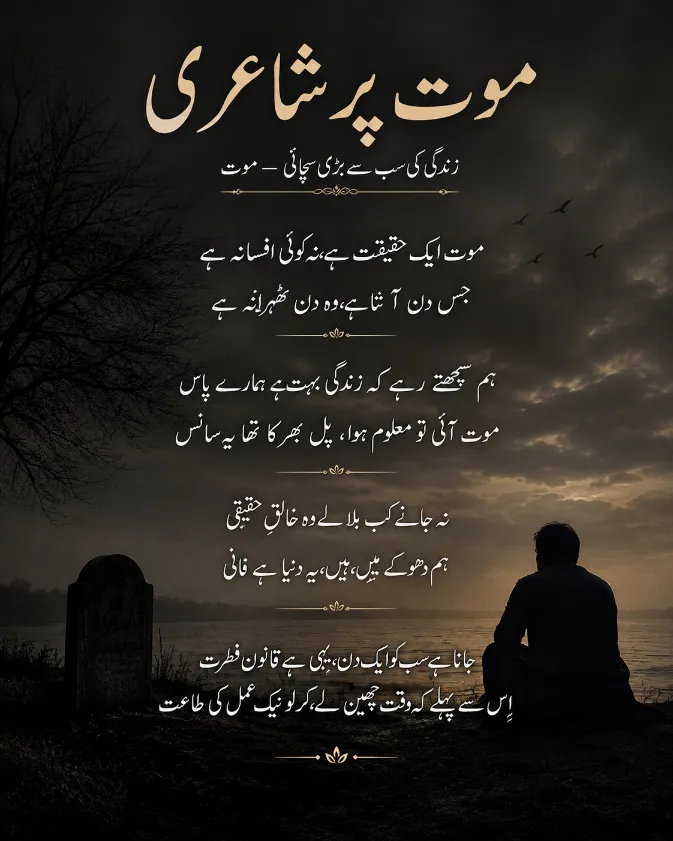
Famous Themes in Urdu Death Poetry
Death poetry can communicate several emotions at the same time. Common themes include:
- Grief after losing a loved one
- Memories of someone who has passed away
- The emptiness created by separation
- The temporary nature of worldly life
- Acceptance of death
- Prayer and remembrance
- Love that remains after death
- Spiritual reflection
- The value of a person’s life and character
- Hope for peace and mercy
These themes make mourning poetry meaningful beyond the immediate moment of loss. A short verse can preserve a memory or give words to emotions that are difficult to express in ordinary conversation.
Marsiya and the Urdu Literary Tradition
Marsiya occupies a distinctive place in Urdu literature. The term generally refers to elegiac poetry, while the Urdu tradition became particularly associated with commemorating the martyrdom of Imam Hussain and the tragedy of Karbala. Research from the University of Karachi notes the development of marsiya as a literary form and its evolving linguistic patterns, metaphors, and narrative techniques.
The genre also developed beyond simple expressions of sorrow. Scholarly research on Urdu marsiya describes its broader thematic development, including questions of justice, sacrifice, tyranny, and human values.
Mir Anis and Mirza Dabeer are among the most prominent names associated with the classical Urdu marsiya tradition. Their work helped establish a sophisticated poetic style in which mourning, narrative, imagery, character description, and moral reflection could work together.
Short Death Poetry in Urdu
Short poetry is often preferred for expressing personal grief because a few lines can communicate strong emotions without lengthy explanation. Such verses may be used in condolence messages, memorial posts, personal diaries, or remembrance gatherings.
Examples of original short expressions include:
یادوں میں وہ شخص آج بھی زندہ ہے
بس ہماری آنکھوں سے اوجھل ہوا ہے
کچھ لوگ بچھڑ کر بھی جدا نہیں ہوتے
وہ یاد بن کر دل میں رہا کرتے ہیں
وقت گزر جاتا ہے، یادیں نہیں جاتیں
اپنے بچھڑ جائیں تو کمی رہ جاتی ہے
خاموش ہے گھر، مگر یادیں بولتی ہیں
وہ شخص نہیں، مگر باتیں بولتی ہیں
These are contemporary-style original verses rather than quotations attributed to classical poets.
Death Poetry About Parents
The death of a parent can create a particularly deep sense of absence. Urdu poetry about a mother or father often focuses on memories, affection, guidance, and the feeling that an important source of emotional support is no longer physically present.
For example:
ماں کی دعا کا سایہ اب یاد آتا ہے
ہر مشکل میں وہ چہرہ یاد آتا ہے
Similarly, poetry about a deceased father may focus on his sacrifices and the lessons he left behind:
وہ ہاتھ جو ہمیشہ سہارا دیتے تھے
اب یادوں میں ہمیں راستہ دیتے ہیں
Such poetry can serve as a personal tribute rather than simply a description of death.
Death Poetry for a Friend
The death of a friend can bring a different kind of grief. Friendship poetry often remembers conversations, shared experiences, laughter, and ordinary moments that become precious after separation.
A simple verse may say:
دوست بچھڑا تو یہ احساس ہوا
کچھ رشتے وقت سے نہیں، دل سے بنتے ہیں
The emotional strength of this type of poetry comes from remembrance. Instead of concentrating only on death, the verse keeps the person’s presence alive through memories.
Philosophical Death Poetry in Urdu
Urdu poetry has also frequently addressed mortality as a philosophical subject. Poets have reflected on the temporary nature of life, the passage of time, fate, and the contrast between human desires and mortality.
Elegiac traditions often use death as an opportunity to reflect on life itself. Persian literary scholarship identifies themes such as the transience of life, the cruelty of fate, personal loss, and mourning among recurring elements of elegiac poetry.
This approach makes death poetry relevant even outside a specific funeral or bereavement. A verse about mortality can encourage reflection on relationships, time, priorities, and the value of human life.
Religious and Spiritual Dimensions
In South Asian Urdu literary culture, mourning poetry may also carry religious and spiritual meanings. Marsiya in particular has a strong historical connection with the remembrance of Karbala and the martyrdom of Imam Hussain.
Research published by Allama Iqbal Open University describes Arabic influences on Urdu marsiya and discusses how poets such as Mir Anis and Mirza Dabeer incorporated religious references, imagery, and literary techniques into their work.
For this reason, Urdu death poetry can range from personal mourning to religious remembrance, depending on the poet, occasion, and audience.
How Death Poetry Helps Express Grief
Poetry does not remove grief, but it can provide language for emotions that are difficult to communicate directly. A carefully chosen verse can express sadness, remembrance, love, and respect in a compact form.
People may use Urdu mourning poetry for:
- Condolence messages
- Memorial posts
- Funeral-related remembrance
- Personal tributes
- Poetry collections
- Religious gatherings
- Remembrance of parents or relatives
- Honoring a deceased friend
- Reflecting on mortality
The value of such poetry lies in its ability to preserve emotion and memory through language.
Difference Between Marsiya and General Death Poetry
Not every poem about death is a marsiya. Death poetry is a broad descriptive term covering different kinds of verses concerning loss, mortality, remembrance, and grief.
Marsiya, however, is a specific literary genre with a significant historical development in Urdu. Its strongest association is with elegiac remembrance, particularly the Karbala tradition. Academic sources describe marsiya as a distinct form that developed its own structure, themes, imagery, and stylistic conventions.
Therefore, a short modern verse written about the death of a parent can be called mourning or death poetry, but it does not automatically become a classical marsiya.
Why Urdu Is Powerful for Mourning Poetry
Urdu has a rich vocabulary for expressing subtle emotional states. Words connected with yaad (memory), judai (separation), gham (sorrow), firaq (separation), and mohabbat (love) allow poets to communicate grief without relying on direct statements alone.
Metaphor, repetition, rhythm, imagery, and rhyme can make a few lines emotionally memorable. Research into Urdu marsiya also identifies the importance of linguistic patterns, metaphor, simile, and changing literary techniques in the genre’s development.
“Final Thoughts”
Death Poetry in Urdu represents a broad tradition of expressing sorrow, remembrance, separation, mortality, and spiritual reflection. From intimate verses about a deceased parent or friend to the highly developed tradition of marsiya, Urdu poetry offers many ways to preserve memories and articulate grief.
The tradition is also part of a much older Persian-Arabic literary heritage, adapted and developed within Urdu literature over generations. Modern Urdu mourning poetry may be short and personal, while classical marsiya can be lengthy, structured, narrative, and deeply connected with historical and religious themes.