
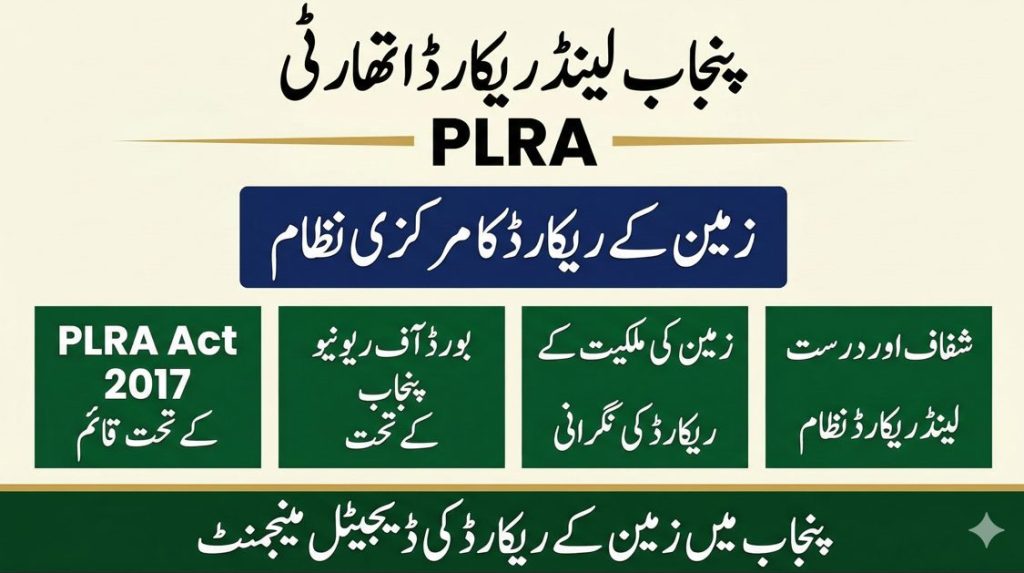
Land Record Punjab Online Check by CNIC is a convenient way for property owners to access Punjab’s computerized land-record services. The Punjab Land Records Authority (PLRA) manages the province’s digital land-record system and provides services such as obtaining a Fard, verifying land documents, checking mutations, and updating CNIC information in land records.
For property-related matters, it is important to use official PLRA services rather than relying on unofficial websites or agents. A CNIC can help establish a person’s identity within the land-record system, but the exact information and service available depend on how the ownership record has been entered and which PLRA service is being used.
What Is Land Record Punjab Online Check by CNIC?
The term refers to checking or accessing computerized land-record information associated with a citizen’s CNIC through Punjab’s official land-record system.
PLRA has digitized land records across Punjab and operates Arazi Record Centres (ARCs) where citizens can obtain services related to ownership and property records. Its official website currently lists services including Get a Fard, apply for partition, download an old e-Registry, and other land-related facilities.
The CNIC is particularly important because ownership records contain identification information. Punjab’s land-revenue rules also provide for the National Identity Card number among the particulars recorded for an owner in the Register Haqdaran Zamin.
Can You Check All Land Details Simply by Entering a CNIC?
Not necessarily.
A common misconception is that a person can enter a CNIC number on any public webpage and immediately receive a complete list of every property owned in Punjab. PLRA’s current official services do not present the process as a simple unrestricted public CNIC search.
The official system provides different services for different purposes. For example, the online Fard system allows users to obtain land-record documents, while the separate verification service allows a Fard or mutation to be verified using information printed on the document.
Therefore, a person should select the appropriate PLRA service rather than assuming that every property record can be displayed through a basic CNIC search.
How to Check Punjab Land Records Online
The general process can be completed through PLRA’s official digital services.
1. Visit the Official PLRA Website
Start with the official Punjab Land Records Authority website:
Punjab Land Records Authority official website
PLRA provides links to its land-record services through its official platform. The website currently includes an option for obtaining a Fard and information about Arazi Record Centres.
2. Select the Relevant Land Record Service
Choose the service that matches your requirement. If you need an official ownership document, the Get a Fard service is generally more relevant than a general search.
A Fard is an official land-record document containing relevant information from the computerized record. PLRA also provides online facilities associated with printing and verifying Fard documents.
3. Provide the Required Identification Details
Depending on the service, you may need your CNIC and other information connected with the property or applicant.
Keep the following details available where applicable:
- CNIC number
- Registered mobile number
- Owner’s name
- District
- Tehsil
- Mouza or village
- Khewat or Khatauni information
- Khasra number
- Relevant Fard or mutation details
Not every service requires all of these details. The information requested depends on the particular PLRA process.
4. Complete Verification
Online services may require identity or account verification. The Registry of Deeds Public Portal, for example, uses the CNIC as the login name and requires a security code. Its registration process also includes mobile or email verification.
This verification helps protect land and property information from unauthorized access.
5. Obtain or Verify the Record
After completing the applicable process, you can access the relevant service or document.
If you already have a Fard, PLRA’s online verification page provides fields for the Fard ID and verification code printed on the document. This is useful for checking whether a Fard document can be verified through the official system.
What Information Can a Punjab Land Record Show?
The information available depends on the record and service. Computerized land records can contain details such as:
| Record Detail | Purpose |
|---|---|
| Owner’s name | Identifies the recorded owner |
| CNIC | Links identity information with the record |
| Khewat number | Identifies an ownership account |
| Khatauni | Provides cultivation/tenancy-related information |
| Khasra number | Identifies a specific parcel |
| Area | Indicates the recorded land area |
| Ownership share | Shows the recorded share of an owner |
| Mutation details | Records changes affecting rights or ownership |
| Fard information | Provides an official extract from the land record |
Punjab’s land-revenue rules specify owner identification, CNIC information, ownership status, shares, area, and survey/Khasra information among the particulars maintained in the land record.
What Is a Fard?
A Fard is an extract from the land record that provides relevant information about ownership and the property recorded in the computerized system.
It can be required for various property-related purposes, including transactions and verification. PLRA provides an online Fard service as well as verification facilities.
A Fard should not be confused with every other property document. A registered deed, mutation, Fard and other revenue records serve different legal and administrative purposes.
How to Verify a Fard Online
If you already possess a Fard issued through the PLRA system, you can use the official verification service.
The PLRA verification page provides separate options for verifying a Fard and a mutation. For Fard verification, the system asks for the Fard ID and verification code shown on the report. (Online Fard)
Use the official verification page:
This is preferable to relying on screenshots, photocopies, or information supplied by an unofficial intermediary.
What If Your CNIC Is Not Linked to the Land Record?
A CNIC-related issue can prevent the computerized record from correctly associating ownership information with you.
PLRA has a dedicated service called CNIC Entered in your Land Record. The authority explains that updating the CNIC in the land record helps keep ownership details accurate and can reduce future record problems. The service can be pursued through the relevant online process or by visiting an Arazi Record Centre.
If your property appears under your name but your CNIC information is missing or incorrect, contacting PLRA or visiting the appropriate Arazi Record Centre is a safer approach than attempting to create duplicate records.
What Are Arazi Record Centres?
Arazi Record Centres, commonly called ARCs, are PLRA service centres where citizens can obtain computerized land-record services.
PLRA states that its ARCs provide one-window services for activities such as obtaining Fard, transferring land, verifying ownership and completing property-related processes. The authority currently lists more than 150 ARCs across Punjab, along with Qanungoi and mobile Arazi Record Centres.
An ARC can be particularly useful if:
- Your CNIC is not linked correctly.
- Your ownership information appears incomplete.
- Online processing is unavailable.
- You need assistance with a land-record document.
- You need to resolve an apparent discrepancy in the computerized record.
Important Things to Remember
Before using an online land-record service, keep these points in mind:
- Use the official PLRA website and its authorized services.
- Never share your CNIC, OTP, password or account credentials with unknown individuals.
- Check the spelling of the owner’s name and property details carefully.
- Keep Fard and mutation verification information confidential.
- Do not assume an online search alone establishes legal ownership in every situation.
- For disputes, inheritance issues, court matters or suspected fraudulent transfers, obtain appropriate professional or legal assistance.
- Visit an Arazi Record Centre if the computerized information is incomplete or incorrect.
Land Record Punjab Online Check by CNIC vs. Fard Verification
These two processes are related but are not identical.
A CNIC-based process concerns identification and association of a citizen with land records. Fard verification is used to authenticate a particular Fard using information contained on that document.
| Feature | CNIC/Record Access | Fard Verification |
|---|---|---|
| Main purpose | Identify/access relevant record services | Verify an issued Fard |
| Main identifier | CNIC and related details | Fard ID and verification code |
| Service provider | PLRA | PLRA |
| Result | Depends on selected service | Verification information |
| Best for | Record access and ownership-related services | Checking an existing Fard |
Understanding this difference can prevent confusion during property transactions.
Are Punjab Land Records Available Online Everywhere?
PLRA has undertaken extensive digitization of land records across Punjab. Its official website reports more than 23,500 digitized Mauzas and millions of digitized Intiqalat and Fardat in its current digital-record statistics.
However, the availability of a particular record or service can depend on the status of the computerized record. A missing online result does not automatically prove that a person has no land or that a historical record does not exist.
For unresolved cases, the appropriate PLRA office or Arazi Record Centre can help determine the correct record position.
“Final Thoughts”
Land Record Punjab Online Check by CNIC is part of Punjab’s broader move toward computerized and more accessible land-record services. PLRA provides online Fard services, document verification, CNIC-related record services and physical Arazi Record Centres for citizens who need additional assistance.
The safest approach is to use official PLRA platforms, provide accurate identification information and verify important property documents through authorized channels. For legal ownership disputes or discrepancies, an online record should be treated as part of the official land-record process rather than as a substitute for professional legal advice.