The K2 Base Camp Trek is widely regarded as one of the most rewarding trekking adventures in the world. Unlike popular hiking destinations with developed tourist facilities, this journey takes you deep into the untouched wilderness of Pakistan’s Karakoram Mountains. Every step reveals massive glaciers, towering granite cliffs, and snow-covered peaks that have inspired climbers and explorers for decades. For many outdoor enthusiasts, reaching K2 Base Camp is a lifetime achievement. While climbing K2 itself is reserved for elite mountaineers, trekking to its base camp allows experienced hikers to witness the world’s second-highest mountain without technical climbing. The route follows the historic Baltoro Glacier, passes through the famous Concordia region, and offers panoramic views of several mountains that rise above 8,000 meters.
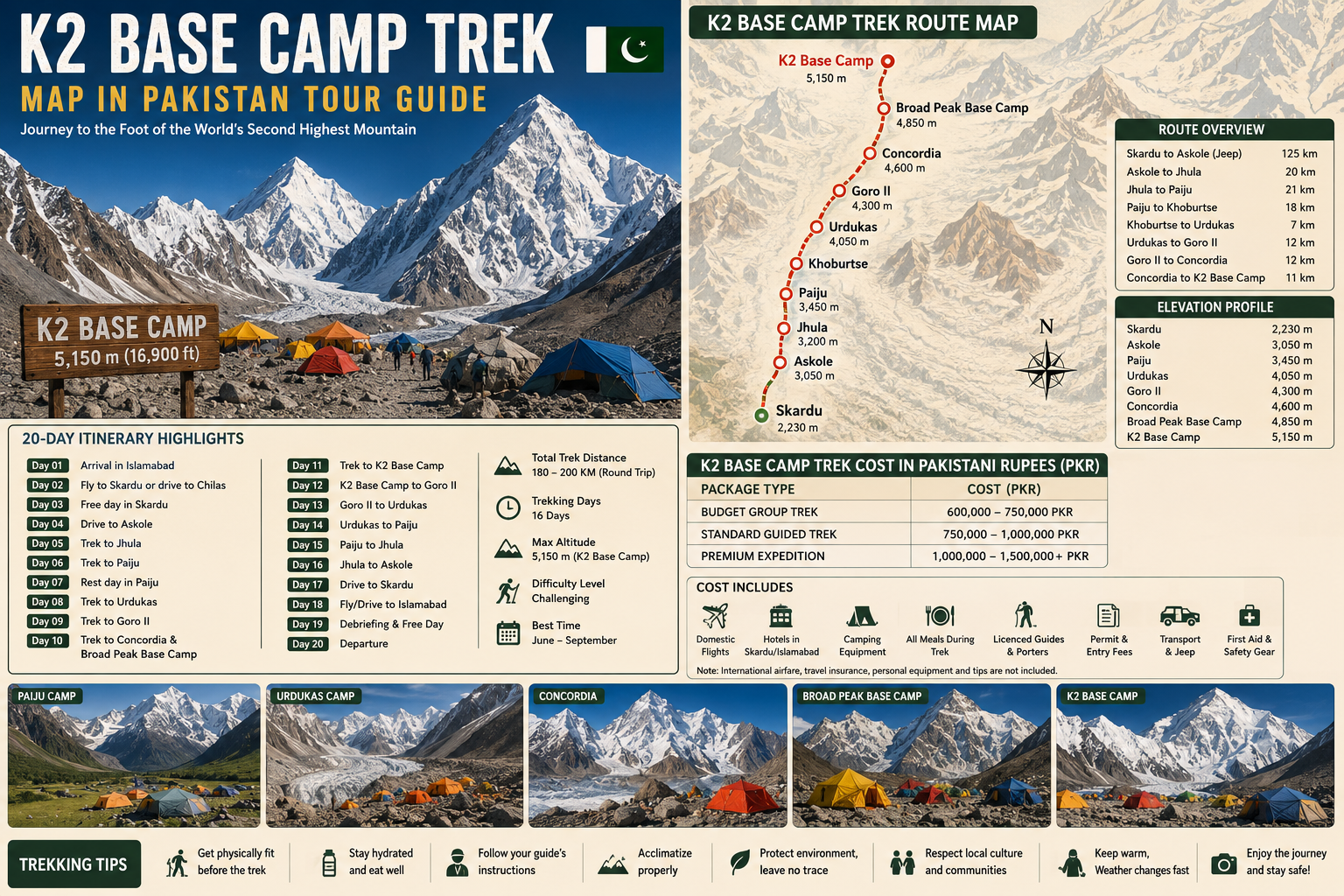
Our guide explains the K2 Base Camp Trek Map in Pakistan, including the complete trekking route, itinerary, distance, elevation, campsites, travel tips, safety advice, and practical information to help you prepare for one of the world’s greatest trekking expeditions.
About K2 Mountain
K2 stands at 8,611 meters (28,251 feet) above sea level, making it the second-highest mountain on Earth after Mount Everest. It is located in the Karakoram Range on the border between Pakistan’s Gilgit-Baltistan region and China’s Xinjiang Autonomous Region.
The mountain was first successfully climbed on 31 July 1954 by Italian climbers Lino Lacedelli and Achille Compagnoni. Since then, K2 has become one of the most respected peaks in mountaineering because of its steep slopes, unpredictable weather, and technical difficulty.
Although K2 is often called the Savage Mountain, the trek to its base camp does not require technical climbing. Instead, it demands good physical fitness, proper acclimatization, and the ability to hike for several consecutive days over rocky and glacial terrain.
Where Is K2 Base Camp?
K2 Base Camp lies at an elevation of approximately 5,150 meters (16,900 feet) on the Godwin-Austen Glacier in Gilgit-Baltistan, Pakistan.
The trek begins in the mountain town of Skardu, which serves as the gateway to many expeditions in the Karakoram. From Skardu, travelers drive to the remote village of Askole, where the trekking journey officially starts.
The complete route follows the Baltoro Glacier through a series of established camps before reaching Concordia and finally K2 Base Camp.
K2 Base Camp Trek Map in Pakistan
Understanding the trekking route before departure helps visitors plan each stage of the journey. The classic K2 Base Camp route is well established and is followed by nearly all trekking groups and mountaineering expeditions.
Standard Trekking Route
Islamabad
      │
      ▼
Skardu
      │
      ▼
Askole
      │
      ▼
Jhula
      │
      ▼
Paiju
      │
      ▼
Khoburtse
      │
      ▼
Urdukas
      │
      ▼
Goro II
      │
      ▼
Concordia
      │
      ▼
Broad Peak Base Camp
      │
      ▼
K2 Base Camp
Most trekkers return along the same route after reaching K2 Base Camp. Some experienced mountaineering expeditions exit through Gondogoro La, but this involves technical climbing equipment and is suitable only for trained climbers.
Overview of the Trekking Route
The journey begins in Islamabad, where international visitors usually arrive before taking a domestic flight to Skardu. If flights are cancelled because of weather, travelers continue by road through northern Pakistan.
After spending time acclimatizing in Skardu, a jeep drive of approximately six to seven hours leads to Askole, the last permanent village before entering the wilderness.
From Askole, the trail follows the Braldu River before reaching Paiju Camp, where trekkers spend an acclimatization day. Beyond Paiju, the route enters the famous Baltoro Glacier, one of the world’s longest glaciers outside the polar regions.
As the trek continues, hikers pass through Khoburtse, Urdukas, and Goro II, with mountain scenery becoming more dramatic each day. The highlight for many visitors is Concordia, where the Baltoro and Godwin-Austen glaciers meet. On a clear day, Concordia offers views of K2, Broad Peak, Gasherbrum I, Gasherbrum II, and several other legendary peaks.
From Concordia, a final day hike leads to Broad Peak Base Camp and then to K2 Base Camp, where trekkers stand beneath one of the most iconic mountains on Earth.
K2 Base Camp Trek Distance
The complete trek covers approximately 180 to 200 kilometers (112 to 124 miles) as a round trip.
Approximate distances between camps are shown below.
| Route | Distance |
|---|---|
| Skardu to Askole (Jeep) | 125 km |
| Askole to Jhula | 20 km |
| Jhula to Paiju | 21 km |
| Paiju to Khoburtse | 18 km |
| Khoburtse to Urdukas | 7 km |
| Urdukas to Goro II | 12 km |
| Goro II to Concordia | 12 km |
| Concordia to K2 Base Camp | 11 km |
Daily walking distances vary depending on weather, trail conditions, and the pace of each trekking group.
Elevation Profile
One of the biggest challenges during the trek is the gradual gain in altitude. Spending adequate time acclimatizing is essential for reducing the risk of altitude sickness.
| Location | Elevation |
|---|---|
| Islamabad | 540 m |
| Skardu | 2,230 m |
| Askole | 3,050 m |
| Paiju | 3,450 m |
| Urdukas | 4,050 m |
| Goro II | 4,300 m |
| Concordia | 4,600 m |
| Broad Peak Base Camp | 4,850 m |
| K2 Base Camp | 5,150 m |
The gradual ascent allows most trekkers to adjust to the increasing altitude before reaching base camp.
Why the K2 Base Camp Trek Is Special
Unlike many famous trekking routes that pass through villages, tea houses, or developed tourist areas, the K2 Base Camp Trek takes visitors into one of the world’s most remote mountain environments.
Along the journey, trekkers experience:
- The Baltoro Glacier stretching for more than 60 kilometers.
- Massive granite towers including the famous Trango Towers.
- Concordia, often called the “Throne Room of the Mountain Gods.”
- Close views of four mountains higher than 8,000 meters.
- Some of the clearest night skies in the Karakoram.
- A true expedition atmosphere supported by local guides, porters, and camp staff.
For photographers, nature lovers, and adventure travelers, few destinations offer such a combination of dramatic landscapes and genuine wilderness.
Complete 20-Day K2 Base Camp Trek Itinerary
A successful K2 Base Camp trek depends on steady progress and proper acclimatization rather than speed. Most organized tours follow a 20-day itinerary that allows trekkers to adjust to the increasing altitude while enjoying the remarkable scenery of the Karakoram. Weather conditions, flight schedules, and trail conditions can occasionally change the plan, so flexibility is an important part of the experience.
Day 1: Arrival in Islamabad
Your journey begins in Islamabad, Pakistan’s capital city. After arriving at the airport, you will be transferred to your hotel. Most trekking companies use this day to conduct a welcome briefing, inspect trekking equipment, and review the expedition schedule.
If time allows, you can visit local attractions or purchase any last-minute items before heading north.
Accommodation: Hotel
Day 2: Fly to Skardu or Drive to Chilas
The preferred option is a morning flight from Islamabad to Skardu. The flight offers unforgettable aerial views of the Himalaya and Karakoram ranges, including Nanga Parbat on clear days.
Mountain weather can affect flights, so an alternative road journey to Chilas is often included in the itinerary.
After arriving in Skardu or Chilas, you will spend the night at a hotel.
Accommodation: Hotel
Day 3: Skardu Exploration and Preparation
If you reached Chilas by road, today’s drive continues to Skardu. Those already in Skardu usually spend the day preparing permits, meeting guides and porters, checking equipment, and allowing the body to begin adapting to the higher elevation.
Skardu is the main gateway for expeditions heading into the Karakoram. It offers markets, hotels, restaurants, and beautiful views of the surrounding mountains.
Many trekkers also visit Shangrila Resort, Upper Kachura Lake, or Skardu Bazaar during their free time.
Accommodation: Hotel
Day 4: Drive from Skardu to Askole
After breakfast, the expedition travels by four-wheel-drive vehicles to Askole, the last permanent village on the K2 Base Camp route.
The drive follows narrow mountain roads beside rivers and valleys before reaching the remote settlement. Mobile signals become unreliable, and modern facilities are limited beyond this point.
Once the equipment is organized, the camping adventure officially begins.
Accommodation: Camp
Day 5: Trek from Askole to Jhula
The first trekking day introduces hikers to the vast landscapes of the Karakoram. The trail follows the Braldu River across rocky terrain with several stream crossings.
Although the altitude gain is moderate, this is an excellent opportunity to establish a comfortable walking pace that can be maintained throughout the expedition.
Camp is set up near Jhula beside the river.
Walking Time: 6–7 hours
Accommodation: Camp
Day 6: Trek from Jhula to Paiju
Today’s hike continues toward Paiju Camp, one of the most important stops on the expedition.
As the trail gradually climbs, the first impressive views of snow-covered peaks begin to appear. Paiju is also the last campsite with scattered vegetation before the route enters the glacier environment.
Many trekking teams enjoy fresh bread prepared by local camp staff, making Paiju a favorite stop along the route.
Walking Time: 6–8 hours
Accommodation: Camp
Day 7: Rest Day at Paiju
Acclimatization is one of the keys to completing the trek safely.
Rather than pushing higher each day, trekkers remain at Paiju to allow their bodies to adjust to the altitude. Light walks around the campsite help improve acclimatization while giving hikers time to rest and enjoy the scenery.
Porters also reorganize supplies before the expedition moves onto the Baltoro Glacier.
Accommodation: Camp
Day 8: Trek from Paiju to Urdukas
This is one of the most memorable days of the trek because the route enters the famous Baltoro Glacier.
Walking across the glacier requires careful footing over loose rocks and glacial moraine. Although the terrain becomes more demanding, the scenery becomes increasingly spectacular.
Towering peaks such as Trango Towers and Cathedral Peak dominate the skyline.
Urdukas Camp sits on a natural terrace overlooking the glacier and provides one of the finest camping locations on the entire trek.
Walking Time: 8–9 hours
Accommodation: Camp
Day 9: Trek from Urdukas to Goro II
The trail continues over glacial terrain toward Goro II.
Snow-covered mountains surround the campsite from every direction, creating one of the most dramatic landscapes in Pakistan.
Temperatures become noticeably colder at this elevation, especially after sunset. Proper clothing is essential to stay comfortable during the night.
Walking Time: 6–7 hours
Accommodation: Camp
Day 10: Trek from Goro II to Concordia and Broad Peak Base Camp
Today is often described as the highlight of the expedition.
The route reaches Concordia, where the Baltoro Glacier meets the Godwin-Austen Glacier. On clear days, trekkers can see K2, Broad Peak, Gasherbrum I, Gasherbrum II, Mitre Peak, and several other famous mountains from one location.
Many expeditions continue toward Broad Peak Base Camp before stopping for the night.
Standing in Concordia is an unforgettable experience, as few places on Earth offer such a concentration of towering peaks.
Walking Time: 6–8 hours
Accommodation: Camp
Day 11: Trek to K2 Base Camp
This is the day that every trekker has been waiting for.
After breakfast, the trail follows the Godwin-Austen Glacier toward K2 Base Camp.
As you approach the mountain, the enormous south face of K2 dominates the landscape. Expedition camps, colorful tents, prayer flags, and climbers preparing for summit attempts create an unforgettable atmosphere.
Many groups spend time taking photographs and enjoying the surroundings before returning to camp later in the day.
Reaching K2 Base Camp is a remarkable achievement and the reward for days of challenging trekking.
Accommodation: Camp
Day 12: Return to Goro II
After visiting K2 Base Camp, the return journey begins.
Descending allows many trekkers to feel stronger as oxygen levels gradually increase. Although the walking distance is long, the familiar route makes the day more comfortable than the ascent.
Accommodation: Camp
Day 13: Trek to Urdukas
The trail follows the Baltoro Glacier back toward Urdukas.
Descending provides another opportunity to appreciate landscapes that looked very different while climbing toward base camp.
Many trekkers notice details they missed during the ascent because they are less focused on altitude and physical effort.
Accommodation: Camp
Day 14: Trek to Paiju
Today’s hike leaves the glacier behind and returns to the greener surroundings of Paiju.
The lower altitude makes sleeping easier, and many trekking groups celebrate reaching this stage of the expedition.
Accommodation: Camp
Day 15: Trek to Jhula
The trail continues through rocky valleys alongside the Braldu River.
Although the hardest part of the expedition is over, hikers should still remain cautious, as uneven terrain can become tiring after many consecutive trekking days.
Accommodation: Camp
Day 16: Trek to Askole
The final day of trekking brings the expedition back to Askole.
Completing the route is a proud moment for every participant. Local guides and porters often celebrate the successful completion of the journey together with the trekking group.
Accommodation: Camp
Day 17: Drive from Askole to Skardu
Four-wheel-drive vehicles transport the group back to Skardu.
After many nights of camping, a comfortable hotel, warm shower, and freshly prepared meal are welcome rewards.
The evening is often spent sharing photographs and stories from the expedition.
Accommodation: Hotel
Day 18: Return to Islamabad
If weather permits, the group flies back to Islamabad.
When flights are cancelled because of mountain weather, travelers return by road according to the alternative itinerary prepared by their trekking operator.
Accommodation: Hotel
Day 19: Free Day and Expedition Debriefing
This day provides flexibility for delayed flights and gives trekkers time to relax before international departures.
Some itineraries include a debriefing with the Alpine Club of Pakistan or the trekking company to review the expedition and complete any necessary formalities.
Visitors often spend their free time exploring Islamabad or shopping for souvenirs.
Accommodation: Hotel
Day 20: Departure
Your K2 Base Camp adventure comes to an end as you transfer to Islamabad International Airport for your onward flight.
Although the expedition is complete, the memories of the Karakoram, Baltoro Glacier, Concordia, and K2 will remain with you for years to come.
Major Camps Along the Route
Each campsite offers a different experience and marks an important stage of the journey.
Askole (3,050 m)
Askole is the last inhabited village before entering the wilderness. Supplies are checked here, and the trekking expedition officially begins.
Jhula
Located beside the Braldu River, Jhula provides an easy introduction to multi-day trekking and serves as the first overnight camp.
Paiju (3,450 m)
Paiju is one of the most comfortable camps on the route. It is surrounded by scattered trees and is commonly used for an acclimatization day before entering the Baltoro Glacier.
Urdukas (4,050 m)
Built on a rocky terrace above the glacier, Urdukas offers some of the finest panoramic views on the trek. Many trekkers consider it one of the most beautiful campsites in the Karakoram.
Goro II (4,300 m)
This campsite sits directly on glacial terrain and is surrounded by snow-covered peaks. Nights here are cold, but the scenery is unforgettable.
Concordia (4,600 m)
Known as the “Throne Room of the Mountain Gods,” Concordia is one of the world’s most famous mountain viewpoints. On clear days, several 8,000-meter peaks are visible from a single location.
Broad Peak Base Camp
This camp is used by climbers attempting Broad Peak and serves as an important stop before visiting K2 Base Camp.
K2 Base Camp (5,150 m)
The destination of the trek, K2 Base Camp provides a close view of the world’s second-highest mountain and offers a glimpse into the life of international climbing expeditions.
Best Time to Visit K2 Base Camp
Choosing the right season is one of the most important decisions when planning a K2 Base Camp trek. The Karakoram Mountains experience extreme weather for much of the year, and the trekking route is only accessible for a limited period.
The trekking season generally runs from late June to early September, when snow levels are lower, mountain passes are open, and expedition support services are operating.
June
Late June marks the beginning of the trekking season. Snow is still visible on many sections of the trail, while glaciers remain in excellent condition. Visitor numbers are relatively low, making this a good option for trekkers who prefer quieter routes.
Average daytime temperatures range between 10°C and 18°C at lower elevations, while nights at higher camps can drop well below freezing.
July
July is considered one of the best months for the K2 Base Camp Trek. Weather conditions are generally more stable, daylight hours are longer, and most commercial expeditions operate during this period.
The valleys are greener, glacier crossings are well established, and visibility is often excellent for photography.
August
August is the busiest month on the trail because many international climbing expeditions attempt K2 and nearby peaks during this time.
Although occasional rain can affect lower elevations, conditions in the Karakoram remain suitable for trekking. Camps become more active, allowing visitors to experience the unique atmosphere of an international mountaineering season.
September
Early September offers cooler temperatures and fewer trekking groups. The skies are often clear after the summer weather begins to settle, providing excellent mountain views.
By the middle of the month, snowfall becomes increasingly likely, and many trekking companies conclude their operations for the season.
Weather Conditions
Weather in the Karakoram changes quickly, even during the trekking season.
Trekkers should be prepared for:
- Warm sunshine during the day.
- Strong winds on exposed glacier sections.
- Freezing temperatures at night.
- Occasional snowfall, even in summer.
- Rapid weather changes within a few hours.
Layered clothing allows hikers to adjust comfortably as temperatures change throughout the day.
K2 Base Camp Trek Difficulty
The K2 Base Camp Trek is widely regarded as one of the most demanding non-technical treks in the world.
Unlike climbing K2, the trek does not require ropes, ice axes, or advanced mountaineering skills. However, it demands excellent physical fitness, mental determination, and careful preparation.
Several factors contribute to the difficulty.
Long Walking Days
Trekkers usually spend 6 to 9 hours walking each day for nearly two weeks.
The combination of distance, uneven terrain, and altitude makes each day physically demanding.
High Altitude
The trail gradually climbs from approximately 3,050 meters in Askole to around 5,150 meters at K2 Base Camp.
As elevation increases, oxygen levels decrease. Even experienced hikers may notice slower walking speeds and increased fatigue.
Glacier Terrain
Much of the route follows the Baltoro Glacier.
Instead of smooth hiking trails, trekkers walk across rocks, loose moraine, ice-covered sections, and uneven surfaces that require careful footing.
Remote Environment
There are no hotels, restaurants, or permanent villages after Askole.
Everything needed during the expedition, including food, camping equipment, and supplies, is carried by porters.
Medical facilities are extremely limited, making preparation even more important.
Physical Fitness Requirements
You do not need climbing experience to complete the trek, but you should arrive in excellent physical condition.
A suitable preparation program should begin several months before departure and include:
- Long-distance hiking.
- Stair climbing.
- Cardiovascular training.
- Strength exercises for the legs and core.
- Walking with a loaded backpack.
Building endurance before the trip allows you to enjoy the scenery instead of struggling with the physical demands.
Permits and Entry Requirements
Most international visitors need a valid visa before traveling to Pakistan. Depending on nationality, travelers may be eligible for an electronic visa through Pakistan’s official immigration system.
In addition to a visa, trekking in the Central Karakoram National Park typically requires permits arranged through a licensed trekking operator. Tour companies usually handle these formalities, including route permissions and required registrations.
Before booking, confirm that your operator includes:
- Trekking permits
- National park fees
- Local guide services
- Porter arrangements
- Camping equipment
- Emergency communication equipment
official website Gilgit Baltistan Tourism: https://visitgilgitbaltistan.gov.pk/
How Much Does the K2 Base Camp Trek Cost?
The total cost depends on the itinerary, group size, services included, and the operator you choose.
As a general guide:
| Package Type | Estimated Cost (USD) | Approximate Cost (PKR) |
|---|
| Budget Group Trek | $2,000–2,500 | PKR 570,000–712,500 |
| Standard Guided Trek | $2,500–3,500 | PKR 712,500–997,500 |
| Premium Expedition | $3,500–5,000+ | PKR 997,500–1,425,000+ |
Many packages include:
- Domestic flights
- Hotels
- Camping equipment
- Meals during the trek
- Licensed guides
- Porters
- Transportation between Skardu and Askole
- Trekking permits
International airfare, travel insurance, personal equipment, and tips are usually not included.
Essential Packing List
Packing wisely makes the trek safer and more comfortable.
Clothing
- Waterproof trekking boots
- Comfortable camp shoes
- Moisture-wicking base layers
- Fleece jacket
- Insulated down jacket
- Waterproof jacket
- Waterproof trousers
- Warm gloves
- Wool hat
- Sun hat
- Thermal socks
Equipment
- Backpack
- Daypack
- Trekking poles
- Sleeping bag suitable for freezing temperatures
- Headlamp
- Water bottles
- Water purification tablets or filter
- Sunglasses with UV protection
- Sunscreen
- Lip balm
- Camera
- Power bank
Personal Items
- Passport
- Travel insurance documents
- Personal medications
- Basic first aid kit
- Toiletries
- Wet wipes
- Hand sanitizer
Altitude Sickness
Altitude sickness is one of the biggest risks during the trek.
Because K2 Base Camp sits above 5,000 meters, every trekker should understand the symptoms.
Common signs include:
- Headache
- Loss of appetite
- Difficulty sleeping
- Nausea
- Fatigue
- Dizziness
If symptoms become severe, descending to a lower elevation is the safest response.
Trekkers can reduce their risk by:
- Walking slowly.
- Drinking plenty of water.
- Eating regular meals.
- Avoiding alcohol.
- Following the planned acclimatization schedule.
- Informing guides immediately if symptoms appear.
Safety Tips
Although thousands of trekkers safely complete the journey each year, careful planning is essential.
For a safer experience:
- Choose a reputable trekking company with experienced local guides.
- Purchase travel insurance that covers high-altitude trekking and emergency evacuation.
- Listen to your guide’s instructions.
- Stay with your group.
- Carry extra warm clothing.
- Protect yourself from strong sunlight with sunglasses and sunscreen.
- Keep drinking water easily accessible throughout the day.
- Respect wildlife, local communities, and the fragile mountain environment.
Responsible Trekking
The Karakoram is one of the world’s most remarkable natural environments, and every visitor shares responsibility for protecting it.
You can help preserve the region by:
- Taking all non-biodegradable waste back with you.
- Avoiding single-use plastics whenever possible.
- Staying on established trails.
- Respecting local customs and traditions.
- Conserving water at campsites.
- Avoiding disturbance to wildlife.
Responsible travel helps ensure future generations can enjoy the same spectacular landscapes.
Frequently Asked Questions
How long does the K2 Base Camp Trek take?
Most guided expeditions last 18 to 20 days, including travel between Islamabad and Skardu.
Is the trek suitable for beginners?
The trek is not recommended for beginners with no hiking experience. Previous multi-day trekking experience and good physical fitness are highly beneficial.
Do I need climbing equipment?
No. The standard K2 Base Camp Trek does not involve technical climbing, so ropes and climbing gear are generally unnecessary.
What is the highest point on the trek?
K2 Base Camp, at approximately 5,150 meters, is the highest point reached on the standard route.
Can I trek independently?
Regulations, permits, and logistics can change over time. Many international visitors complete the trek through licensed local operators, which also simplifies transportation, permits, camping, and safety arrangements.
Is there mobile network coverage?
Mobile coverage is generally available in Islamabad, Skardu, and parts of Askole. Beyond Askole, reliable mobile service is extremely limited or unavailable.
Is the K2 Base Camp Trek worth it?
For many trekkers, the answer is yes. The combination of the Baltoro Glacier, Concordia, and the towering peaks of the Karakoram creates an experience unlike almost any other trekking destination in the world.
Conclusion
The K2 Base Camp Trek is more than a hike through the mountains. It is an expedition into one of the most remote and awe-inspiring landscapes on Earth. From the welcoming streets of Skardu to the vast Baltoro Glacier and the unforgettable views at Concordia, every stage of the journey offers something unique.
Reaching K2 Base Camp requires commitment, preparation, and respect for the challenges of high-altitude trekking. Those who take the time to train properly, travel with experienced guides, and follow safe trekking practices are rewarded with an adventure that few places in the world can match.
Whether your goal is to stand beneath the world’s second-highest mountain, photograph the dramatic scenery of the Karakoram, or simply experience one of the planet’s greatest trekking routes, this expedition promises memories that will last a lifetime.