
The phrase Non Demi Curious Semi Binary Meaning has attracted attention because it sounds like a combination of several LGBTQ+ identity terms. However, it is important to separate established terminology from phrases that appear online as jokes, memes, social-media descriptions, or informal wordplay. “Non-demi-curious semi-binary” does not have a recognized, universal definition in major psychological or gender-identity terminology.
To understand the phrase properly, it helps to examine the individual words—particularly nonbinary, demi, curious, and semi-binary—and then consider how they might be combined.
Is “Non Demi Curious Semi Binary” an Official Gender Identity?
No. There is currently no broadly accepted academic, medical, or professional definition of “non-demi-curious semi-binary” as a specific gender identity.
By contrast, nonbinary is an established umbrella term. The American Psychological Association’s Dictionary of Psychology describes nonbinary identities as gender identities in which a person’s internal sense of gender does not align exclusively with the categories of male and female. It can include a wide range of experiences and identities.
Research literature similarly describes nonbinary and genderqueer as broad terms used for identities that fall outside traditional male/female categories.
This distinction matters because an unfamiliar phrase should not automatically be treated as an official identity simply because it contains established terminology.
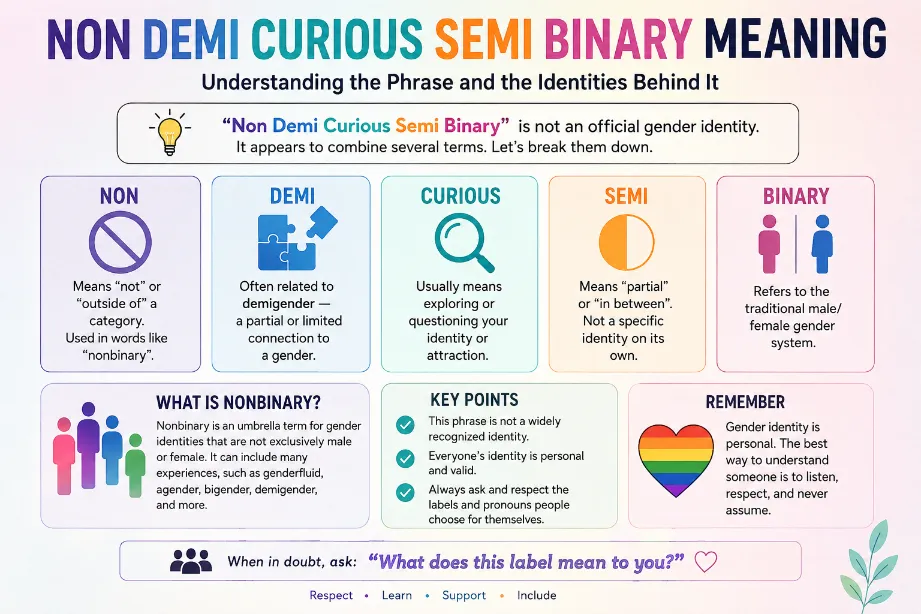
Breaking Down the Phrase
The easiest way to understand the expression is to examine each component separately.
1. Non
In ordinary language, “non” means not or outside a particular category. In LGBTQ+ terminology, it appears in words such as “nonbinary.”
However, “non” by itself does not define a person’s gender identity. Its meaning depends on the word that follows it.
2. Demi
The prefix “demi” can have different meanings depending on the identity term.
For example, demigender describes an identity involving a partial or limited connection to a particular gender. Related terms include demiboy and demigirl. These identities are generally discussed within the broader nonbinary spectrum.
It is also important not to confuse demigender with demisexual. Demisexuality concerns sexual attraction, whereas gender identity concerns a person’s internal understanding of their gender.
These are different aspects of identity.
3. Curious
“Curious” is commonly used informally to describe someone who is exploring or questioning an aspect of their identity or attraction.
For example, terms such as “bi-curious” have historically been used by some people to describe uncertainty or exploration regarding sexual attraction. But “curious” is not, by itself, a standardized gender identity.
Therefore, attaching “curious” to “demi” does not automatically create a recognized identity category.
4. Semi-Binary
“Semi-binary” is not a universally standardized identity label.
Someone might use the expression informally to describe a gender experience that has some connection with the male/female binary while also extending beyond it. However, different people could use the phrase differently.
Established terms such as demigender, genderfluid, bigender, or nonbinary may describe particular experiences more precisely, depending on what an individual actually means.
The important point is that identity terminology is personal. A label should not be assigned to someone based solely on how their identity appears from the outside.
What Does Nonbinary Mean?
Nonbinary is one of the most useful established concepts for understanding this discussion.
The traditional gender binary treats male and female as two exclusive categories. A nonbinary identity does not fit exclusively within that framework.
The APA notes that nonbinary identities can include experiences involving both genders, changing between genders, or existing outside the gender binary altogether.
A person may therefore identify as:
- Nonbinary
- Genderfluid
- Agender
- Bigender
- Genderqueer
- Demigender
- Another gender-diverse identity
- Simply nonbinary without using a more specific label
These terms overlap in some cases, but they are not interchangeable. A person can decide which term, if any, best describes their experience.
Nonbinary vs. Gender Expression
Another common source of confusion is the difference between gender identity and gender expression.
Gender identity refers to how someone understands their own gender internally. Gender expression refers to how that person presents themselves through clothing, hairstyle, behavior, voice, or other forms of presentation.
A person can have a traditionally masculine or feminine appearance while identifying as nonbinary. Conversely, someone who dresses in an androgynous way does not necessarily identify as nonbinary.
Appearance alone cannot reliably tell you someone’s gender identity.
Could “Non Demi Curious Semi Binary” Be a Joke or Internet Phrase?
Yes. This is an important possibility when encountering the phrase online.
The expression has circulated on social media and online discussions in contexts where people have attempted to interpret it humorously or literally. Some online explanations treat the words as a deliberately complicated combination of identity terminology rather than as a formal identity category.
Because there is no established consensus definition, interpretations can vary significantly.
That means readers should be cautious about articles or posts that present the phrase as though it were an officially recognized LGBTQ+ identity with one precise definition.
An online phrase can become popular without becoming an established term in psychology, sociology, medicine, or LGBTQ+ terminology.
Why Established Terminology Matters
Gender terminology evolves as people develop language to describe their experiences more accurately. Academic literature recognizes that terminology surrounding identities outside the gender binary has changed over time and that multiple overlapping terms are used.
At the same time, using established definitions helps prevent unnecessary confusion.
For example:
| Term | General meaning |
|---|---|
| Nonbinary | Gender identity that is not exclusively male or female |
| Genderfluid | Gender identity that may change over time |
| Agender | Identity involving little or no sense of gender |
| Bigender | Identifying with two genders |
| Demigender | Partial connection to a particular gender |
| Genderqueer | Broad term for identities outside conventional gender categories |
| Semi-binary | Informal/non-standard term whose meaning can vary |
| Non-demi-curious semi-binary | Not a widely standardized identity; meaning depends on context |
The definitions above should be treated as general explanations rather than rules that determine how an individual must identify.
Does the Phrase Describe Sexual Orientation?
Not necessarily.
This is another important distinction. Gender identity and sexual orientation are separate concepts.
Gender identity concerns who someone understands themselves to be in terms of gender. Sexual orientation concerns patterns of romantic, sexual, or emotional attraction.
Therefore, a phrase containing words such as “demi” or “curious” should not automatically be interpreted as describing someone’s sexual orientation.
For example, demisexual is generally used for a sexual orientation involving sexual attraction that occurs only under particular circumstances, commonly after a strong emotional connection. That is different from demigender, which concerns gender identity.
The similar prefix can create confusion, but the concepts are not the same.
How Should You Respond When Someone Uses This Label?
If someone personally describes themselves using “non-demi-curious semi-binary,” the most respectful approach is to avoid assuming what they mean.
Instead, you can simply ask:
“What does that label mean to you?”
This gives the person an opportunity to explain their own terminology.
It is also reasonable to ask which pronouns they use if pronouns are relevant to the conversation. Nonbinary people do not all use the same pronouns, and pronouns cannot reliably be inferred from someone’s appearance.
If you make a mistake, a brief correction and apology is generally more appropriate than turning the conversation into a lengthy discussion about the mistake.
Why There Is No Single Definition
Identity labels are not mathematical formulas. Two people may use the same informal term while understanding it somewhat differently.
This is particularly relevant for newer internet terminology. A phrase can begin as humor, become a social-media trend, and then acquire different interpretations as people repeat it.
Consequently, it is better to distinguish between:
- Established terminology supported by professional or academic sources.
- Community terminology that may be meaningful to particular groups.
- Informal internet language that may not have a stable definition.
“Nonbinary” falls clearly within established terminology. “Non-demi-curious semi-binary,” on the other hand, does not currently have the same standardized status.
The Non Demi Curious Semi Binary Meaning is best understood with caution because the complete phrase is not an established identity term with a universally agreed definition. Rather than treating every viral phrase as an official LGBTQ+ category, it is more useful to look at the recognized concepts contained within or associated with it.
Nonbinary is a well-established umbrella term, while terms such as demigender and genderfluid describe particular experiences within the broader landscape of gender diversity.
Ultimately, the most accurate interpretation of an individual’s identity comes from that individual. When an unfamiliar label appears online, checking reputable sources and asking the person what they mean is usually more reliable than assuming a single definition.
What is the Non Demi Curious Semi Binary Meaning?
The phrase does not have one universally accepted meaning. It appears to combine several terms associated with gender or sexuality, but it is not a standardized identity category in major professional terminology.
Is non-demi-curious semi-binary a real identity?
People can personally use any label that helps them describe their experience. However, the complete phrase is not a widely recognized or standardized gender identity.
Is semi-binary the same as nonbinary?
Not necessarily. Nonbinary is an established umbrella term for gender identities that are not exclusively male or female. “Semi-binary” is less standardized and may be interpreted differently by different people.
Is demi the same as demisexual?
No. Demisexuality relates to sexual attraction, while demigender identities relate to gender. The shared “demi” prefix does not make the concepts equivalent.
Can someone identify as nonbinary and another identity at the same time?
Yes. Some people use nonbinary as their primary label while also using a more specific identity such as genderfluid, bigender, agender, or demigender. The terminology someone chooses is personal.